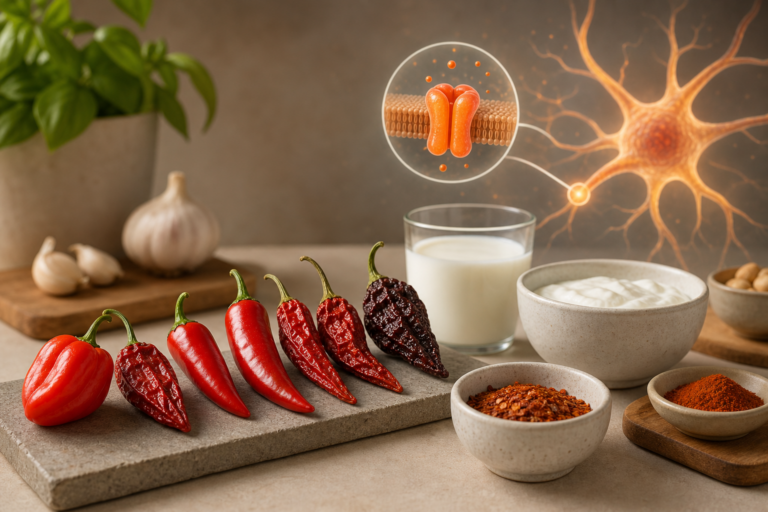
What Capsaicin Does to Your Body (and Why It Feels So Good)
Bite into a jalapeño and your mouth burns, your eyes water, and your heart rate climbs — yet millions of people actively seek out that sensation every single day. The reason comes down to a single molecule called capsaicin and the surprisingly sophisticated way it hijacks your nervous system.
The Molecule Behind the Heat
Capsaicin (8-methyl-N-vanillyl-6-nonenamide) is the primary heat-producing compound in chili peppers of the genus Capsicum. It was first isolated in 1816 by the chemist Christian Bucholz, though its exact chemical structure was not confirmed until 1919. The compound is an alkaloid concentrated mainly in the white pith and inner walls of the pepper — not, as many people assume, primarily in the seeds. It has no colour, flavour, or calories of its own. Only that unmistakable, searing burn.
Crucially, the “heat” capsaicin produces is entirely neurological, not thermal. Your tongue does not actually get hotter when you eat a chilli. The molecule simply persuades your nervous system that it does.
TRPV1: The Receptor That Makes It All Happen
The key to understanding capsaicin is a protein called TRPV1 — Transient Receptor Potential Vanilloid 1. TRPV1 is an ion channel found on the surface of sensory nerve cells distributed throughout the body: your mouth, throat, skin, gastrointestinal tract, and even your bladder all carry it. Under normal circumstances, TRPV1 acts as a heat detector, opening up and sending a pain signal to the brain when temperatures rise above roughly 43 °C (109 °F), the point at which heat begins to damage tissue.
Capsaicin binds directly to TRPV1 in what researchers describe as a “tail-up, head-down” configuration, slotting into the receptor with remarkable specificity through hydrogen bonds between its vanillyl head group and specific amino acid residues. When it does, the channel opens — flooding the nerve cell with calcium and sodium ions and triggering the same electrical alarm that genuine, dangerous heat would send. Your brain receives a warning that something dangerously hot is happening and responds accordingly, even though no actual tissue damage is occurring.
This is also why drinking cold water offers only fleeting relief: the capsaicin molecule remains bound to TRPV1, continuing to send its false alarm. Fat-soluble dairy proteins such as casein in milk are far more effective because they physically displace capsaicin from the receptor, cutting off the signal at its source.
The Body’s Emergency Response
Once TRPV1 fires, the body launches a coordinated stress response. You sweat, your heart rate rises, blood vessels near the skin dilate (producing that flushed face), and mucous membranes ramp up secretions. The digestive tract also accelerates, which is why very spicy meals can speed their own transit through the gut.
The activated nerve fibres also release a neuropeptide called Substance P, a key chemical messenger in pain signalling that amplifies and broadcasts the distress signal across local nerve networks. With a single fiery bite, a small but real cascade of alarm chemistry is set in motion throughout the body.
Why It Feels Good: Endorphins and the Reward System
Here is where things get interesting. In response to what it interprets as a genuine threat, the brain begins releasing endogenous opioids — its own built-in painkilling chemicals. One well-studied pathway involves proopiomelanocortin (POMC), a precursor protein from which β-endorphin is cleaved. Research published in PubMed Central found that capsaicin administration significantly elevated POMC mRNA levels in the arcuate nucleus of the hypothalamus within just 20 minutes, indicating that the brain was ramping up endorphin production in direct response to the perceived danger. The researchers concluded that the analgesic effect of capsaicin is linked to increased activity of the cerebral opioid system.
More direct evidence comes from a 2025 study published in Social Cognitive and Affective Neuroscience. Using event-related potential (ERP) recording with 45 participants, researchers found that eating spicy food shortened reaction times to painful stimuli, reduced self-reported pain intensity, and dampened both the early sensory brain response (the N1 component) and the affective-motivational response to pain (the P2 component). The authors identified three overlapping mechanisms at work: β-endorphin release (supported by evidence that subcutaneous capsaicin elevates endorphin concentrations in cerebrospinal fluid), engagement of the brain’s reward circuitry, and conditioned pain modulation — a process where one pain input actually suppresses another through the body’s natural inhibitory pathways.
That reward circuitry piece is central to the appeal. Endorphins interact with opioid receptors in the brain, and one consequence is a release of dopamine in the nucleus accumbens — the same reward hub activated by food, music, and physical exercise. The result is a mild but genuine sense of well-being that follows the initial burn. For regular spicy-food eaters, the brain learns to anticipate this reward, which helps explain why the craving for heat can grow with experience rather than diminish.
Capsaicin as Medicine: The Pain Paradox
The same molecule that ignites pain can also extinguish it — and this paradox forms the basis of a well-established class of clinical treatments. When capsaicin is applied repeatedly to the same location, TRPV1 receptors undergo a process called desensitization: their sensitivity diminishes, local stores of Substance P become depleted, and the nerve endings temporarily lose their ability to signal pain effectively. Initially you feel more; eventually you feel less.
This mechanism underlies the FDA-approved 8% capsaicin patch used to treat postherpetic neuralgia (the nerve pain that lingers after shingles) and HIV-associated neuropathic pain. According to clinical reviews, a single one-hour application can provide relief beginning approximately three days after treatment and lasting around five months. Lower-concentration creams (typically 0.025–0.1% capsaicin) are widely available over the counter for osteoarthritis, diabetic nerve pain, and muscle aches. The Neuropathic Pain Special Interest Group of the International Association for the Study of Pain has formally recommended capsaicin as a second-line treatment for peripheral neuropathic pain.
Beyond Pain: Other Effects on the Body
Because TRPV1 receptors appear throughout the body — not just on pain-sensing nerve fibres — capsaicin’s biological reach extends into several other systems:
- Metabolism and weight: TRPV1 activation in brown adipose tissue increases energy expenditure, and some studies suggest capsaicin modestly suppresses appetite. However, a large U.S. epidemiological dataset from 2003–2006 found that higher chili consumption was associated with increased BMI in certain demographic groups — a reminder that promising laboratory results do not always translate directly to real-world populations.
- Cardiovascular effects: Capsaicin stimulates release of calcitonin gene-related peptide (CGRP), a potent vasodilator, which may partly explain observed blood pressure reductions in some studies. Its anti-inflammatory properties are also thought to contribute to potential cardiovascular benefits.
- Blood sugar regulation: Animal studies have associated TRPV1 activation with improved insulin secretion and glucose tolerance, though robust human clinical data are still limited.
- Cancer research: Capsaicin has shown pro-apoptotic (cell-death-inducing) effects in certain cancer cell lines in the laboratory, but has also been linked to potentially carcinogenic effects in other contexts. This area remains actively contested and should not inform decisions about supplementation.
Common Myths About Capsaicin
Does spicy food cause stomach ulcers?
This is one of the most persistent misconceptions about capsaicin. Peptic ulcers are overwhelmingly caused by Helicobacter pylori bacteria or long-term use of non-steroidal anti-inflammatory drugs — not chili peppers. Some research even suggests capsaicin may mildly protect the gastric lining by stimulating mucus production, though people with pre-existing gastritis or acid reflux should still exercise caution, as capsaicin can aggravate already-inflamed tissue.
Will eating spicy food get you dramatically “high”?
The endorphin and dopamine release is real, but modest — a pleasant neurochemical lift rather than an intoxicating euphoria. The intensity also varies enormously between individuals, and people who eat spicy food regularly develop tolerance to both the burn and the accompanying buzz, so long-time heat seekers may barely notice what would floor a first-timer.
Are oral capsaicin supplements as effective as topical treatments?
Not according to current evidence. Oral capsaicin supplements are not approved by the FDA for any medical use, and the clinical evidence behind most health claims for them remains thin. The well-documented benefits of capsaicin — particularly for neuropathic pain — are almost exclusively tied to pharmaceutical-grade topical preparations at controlled concentrations, not dietary capsules.
FAQ
Why does milk soothe the burn better than water?
Capsaicin is fat-soluble, not water-soluble, so water merely spreads it around your mouth rather than removing it. Milk contains casein proteins that physically bind to capsaicin molecules and carry them away from TRPV1 receptors, interrupting the pain signal. The fat in full-fat milk also helps dissolve the compound, making whole milk or cream particularly effective at quenching the fire.
Why do some people love spicy food while others find it unbearable?
Individual differences in TRPV1 receptor density, baseline pain sensitivity, prior exposure history, and the strength of one’s dopamine reward response all play a role. People raised in cuisines where spicy food is common often build tolerance early and may experience a stronger reward signal for the same level of heat. There is also emerging evidence that genetic variation influences how sensitive a person’s TRPV1 channels are at baseline, independent of cultural exposure.
Can you lose your tolerance to capsaicin if you stop eating spicy food?
Yes, and it can happen relatively quickly. Without ongoing exposure, TRPV1 receptors gradually return to their baseline sensitivity and local Substance P stores replenish. Even veteran chilli-heads find their spice threshold drops noticeably after an extended break — though tolerance typically rebuilds faster the second time around than it did originally.
Sources
- pmc.ncbi.nlm.nih.gov
- ncbi.nlm.nih.gov
- pmc.ncbi.nlm.nih.gov
- academic.oup.com
- pmc.ncbi.nlm.nih.gov
- webmd.com
- sciencedirect.com
- sciencedirect.com
Related Articles