The Scoville Scale Explained: What the Numbers Really Mean About Pepper Heat
If you have ever squinted at a hot sauce bottle and wondered what 50,000 SHU actually feels like on your tongue, you are not alone. The Scoville scale is the universal language of pepper heat — and once you understand how it works, those numbers become genuinely useful.
A Pharmacist, a Pain Reliever, and a Problem to Solve
The scale takes its name from Wilbur Scoville, an American pharmacist who in 1912 was working at the Parke-Davis pharmaceutical company on a topical heat rub — something akin to a modern IcyHot — that used capsaicin derived from chili peppers as its active ingredient. To formulate the product consistently, Scoville needed a reliable way to compare the potency of different pepper varieties. His solution was a standardised tasting protocol he called the Scoville Organoleptic Test, and it produced the unit we still cite today: the Scoville Heat Unit (SHU).
The Original Method: Human Tasters as Instruments
The organoleptic test was elegant in concept. A precise weight of dried pepper was dissolved in alcohol to extract the capsaicinoids — the family of chemical compounds responsible for heat. That extract was then progressively diluted into a sweetened water solution and offered to a panel of five trained tasters. Starting from a weaker dilution and moving to stronger ones, each taster sampled the series until at least three of the five could detect warmth. The dilution factor at that threshold became the SHU rating, always recorded in multiples of 100.
To picture it: a jalapeño requiring one part extract in 5,000 parts water before its heat disappeared would earn 5,000 SHU. A habanero needing 200,000 parts of water per part of extract earns 200,000 SHU. The larger the number, the more dilution is required — and the more capsaicin is present.
The method had a fundamental flaw, however. Human taste buds are not precision instruments. Testers differ in natural sensitivity, and repeated sampling causes a rapid dulling of perception known as sensory fatigue. Results from the same pepper tested in different laboratories could diverge by as much as 50 percent. The scale was useful but far from objective.
How Heat Is Measured Today: HPLC Takes Over
Beginning in the 1980s, laboratories began replacing tasting panels with High-Performance Liquid Chromatography (HPLC) — an analytical chemistry technique that separates, identifies, and quantifies individual compounds in a sample with far greater precision than any human palate. A pepper extract is dissolved in solvent and forced under high pressure through a tightly packed column. Different capsaicinoid molecules travel through the column at different speeds, allowing a detector to measure each one individually.
Results are initially expressed in parts per million (ppm) and reported as ASTA Pungency Units — a standard set by the American Spice Trade Association. These are then converted to SHU by multiplying by a factor of roughly 15 to 16. So a modern SHU rating is still technically a Scoville number, but it is derived from chemistry rather than a panel of tasters, making it far more reproducible and consistent between labs.
HPLC also allows scientists to measure individual capsaicinoids separately. The two dominant ones are capsaicin (theoretically 16,000,000 SHU in pure form) and dihydrocapsaicin (around 15,000,000 SHU). Their ratio — alongside smaller amounts of related molecules like nordihydrocapsaicin — influences not just how hot a pepper feels but the character of the burn: whether it hits fast at the tip of the tongue, builds slowly at the back of the throat, or lingers long after you have swallowed.
What Capsaicin Actually Does in the Body
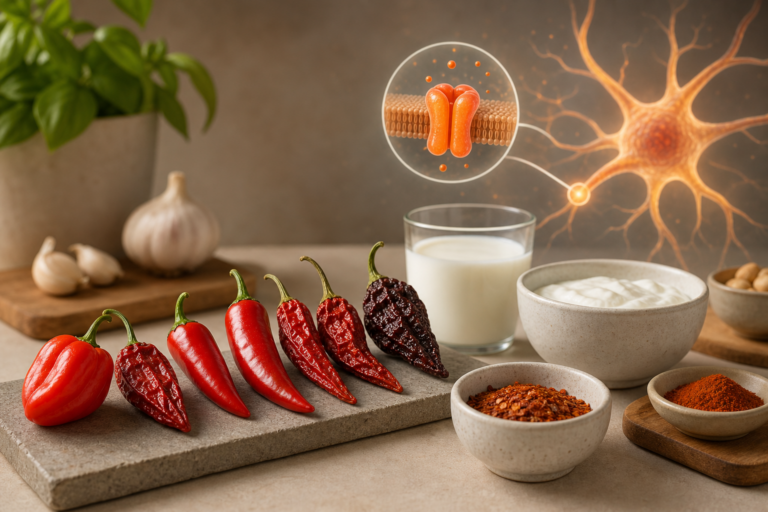
The reason SHU numbers correspond to real physical sensation comes down to a single protein receptor: TRPV1 (Transient Receptor Potential Vanilloid 1). This receptor normally responds to genuine heat above about 43 °C, signalling to your brain that something dangerously hot is in contact with tissue. Capsaicin binds to TRPV1 and triggers precisely the same alarm — which is why your mouth interprets a chili pepper as burning even if it is ice cold. The sweating, watering eyes, and flushed skin that follow are real physiological responses; the tissue damage is absent entirely.
This also explains why water provides so little relief. Capsaicin is fat-soluble rather than water-soluble, so water rolls around the molecules without dislodging them from receptors — and can even spread them further. Dairy products such as full-fat milk, yoghurt, and ice cream contain both fats that dissolve capsaicin and casein proteins that physically bind to it, pulling the compound away from TRPV1 receptors far more effectively.
A Tour of the Scale: Landmark Peppers and Their SHU Values
Seeing where familiar peppers sit on the scale turns abstract figures into something tangible:
- Bell pepper — 0 SHU: A recessive gene mutation prevents any capsaicin production whatsoever. Zero heat, always.
- Banana pepper / Pepperoncini — 100–500 SHU: A barely perceptible tickle that most people experience as mild tang rather than burn.
- Poblano — 1,000–2,000 SHU: The gentle warmth behind dishes like chiles rellenos — earthy, mild, and approachable.
- Jalapeño — 2,500–10,000 SHU: The benchmark for most palates. At the lower end it tastes more vegetal than hot; at the upper end it delivers a genuine, lasting tingle.
- Cayenne — 30,000–50,000 SHU: The workhorse of dried chili powder; real heat with good persistence.
- Thai bird’s eye chili — 50,000–100,000 SHU: Small and fierce, central to South-East Asian cooking — a sharp, penetrating burn that arrives quickly.
- Habanero / Scotch bonnet — 100,000–350,000 SHU: Heat that builds rapidly and lingers for several minutes, paired with distinctive fruity and floral aromatics.
- Ghost pepper (Bhut Jolokia) — 855,000–1,041,427 SHU: The first pepper to officially breach the 1 million SHU mark, certified by Guinness World Records in 2007. Still used as a component in certain military-grade irritant formulations.
- Carolina Reaper — approximately 1,400,000–2,200,000 SHU: Developed by Ed Curlin of PuckerButt Pepper Company in South Carolina; held the Guinness World Record for several years.
- Pepper X — approximately 2,693,000 SHU: Also created by Ed Curlin, Pepper X currently holds the Guinness World Record as the hottest pepper ever officially tested.
For perspective: pure capsaicin sits at a theoretical 16,000,000 SHU — roughly six times hotter than Pepper X — and commercial law-enforcement pepper spray typically registers in the 2,000,000–5,000,000 SHU range.
Why Pepper Heat Is Always Given as a Range
You will rarely see a single, definitive SHU figure attached to a pepper variety, and that is not vagueness — it is accuracy. A pepper’s capsaicin content is shaped by soil composition, water availability, growing temperature, sunlight exposure, and the ripeness of the fruit at harvest. Hot peppers grown under drought conditions and high temperatures tend to accumulate more capsaicin than those given plentiful water and shade. Two peppers pulled from the same plant on the same day can return meaningfully different SHU readings. Cross-pollination between nearby varieties can shift heat levels unpredictably as well.
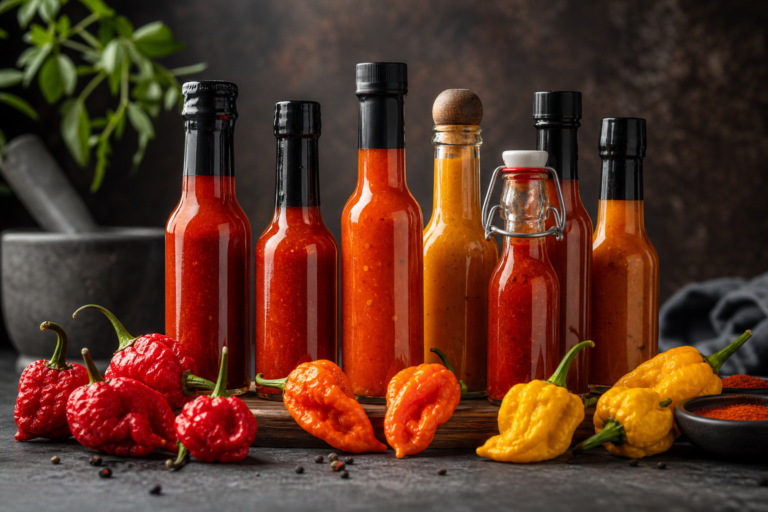
Processed products add another layer. A hot sauce made with habaneros might list 5,000–30,000 SHU on the label despite using a pepper that measures 100,000–350,000 SHU on its own, because vinegar, water, fruit pulp, and other ingredients dilute the capsaicin. The SHU printed on the bottle reflects the finished product — which is the number that actually matters when you are pouring it over your food.
FAQ
Is a higher SHU always hotter tasting?
Generally yes, but the relationship is not perfectly linear for every person. Individual heat tolerance varies considerably: a dish at 10,000 SHU may feel barely warm to a seasoned chili enthusiast but overwhelming to someone with low tolerance. The ratio of different capsaicinoids also affects the character of the burn — some peppers deliver a fast, sharp spike while others build slowly into a deep warmth at the same overall SHU, depending on the balance of capsaicin to dihydrocapsaicin and other compounds present.
Does cooking destroy capsaicin and lower the SHU?
Capsaicin is a chemically stable molecule that survives normal cooking temperatures without breaking down. Adding large amounts of fat, dairy, sugar, or acid to a dish can reduce the perceived heat by diluting or binding the capsaicin — but the molecule itself remains intact. The SHU of the raw pepper ingredient stays the same; the overall pungency of the finished dish decreases because the capsaicin becomes more dispersed throughout the food.
Why does milk help more than water when something is too spicy?
Because capsaicin is fat-soluble, it does not dissolve in water. Drinking water after a very hot bite can actually spread capsaicin across a wider area of the mouth, temporarily intensifying the burn. Dairy products — milk, yoghurt, ice cream — contain fats that dissolve capsaicin and casein proteins that physically bind to the molecule, pulling it away from TRPV1 heat receptors far more effectively than water ever can.
What does the SHU number on a hot sauce label really tell me?
On a finished hot sauce, the SHU reflects the pungency of the whole product, not just the raw pepper used. Because hot sauces dilute peppers with vinegar, water, fruit, and other ingredients, the sauce’s SHU is typically far lower than the base pepper’s natural rating. A habanero hot sauce might carry 5,000–30,000 SHU — well below the habanero’s natural 100,000–350,000 SHU range. The label number tells you how hot the sauce itself will taste, which is ultimately the more useful figure.
Sources
- en.wikipedia.org
- nist.gov
- culinarylore.com
- chilipeppermadness.com
- scovillescale.org
- bonnieplants.com
- heatonist.com
Related Articles