Are Spicy Foods Good for You? What Capsaicin Research Actually Shows
That burning sensation from a hot chili is no accident — it is the work of capsaicin, the bioactive compound responsible for pepper heat, and it turns out it does far more to your body than make your eyes water. A growing body of research suggests that regular, moderate consumption of spicy foods may carry real health benefits, though the picture is more nuanced than most headlines let on.
What Is Capsaicin and How Does It Work?
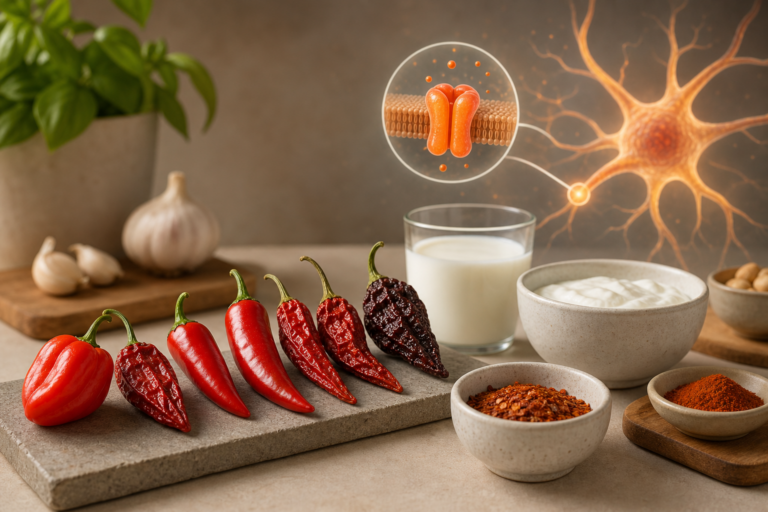
Capsaicin (8-methyl-N-vanillyl-6-nonenamide) is the primary pungent compound in chili peppers of the genus Capsicum. When you eat a spicy dish, capsaicin binds to a protein channel called TRPV1 (transient receptor potential vanilloid 1), found on sensory nerve endings throughout the body — from the tongue and gut to the skin. TRPV1 is a heat-sensing ion channel, which is why capsaicin tricks your nervous system into perceiving warmth or burning even when nothing physically hot is present.
This receptor interaction underpins nearly every health effect attributed to capsaicin. Because TRPV1 is expressed widely across the body — in the digestive tract, cardiovascular tissue, adipose tissue, and the nervous system — researchers have discovered that capsaicin’s reach extends well beyond a fiery aftertaste.
Heart Health: A Striking Population-Level Signal
Perhaps the most dramatic finding in spicy-food research concerns mortality. A large umbrella review, published in Nutrients in 2023, synthesised 11 meta-analyses covering 27 distinct health outcomes related to capsaicin and chili pepper consumption. It found that habitual chili pepper consumption was associated with roughly a 25% lower risk of all-cause mortality and about a 23% reduction in cancer-related mortality, with cardiovascular deaths also significantly lower among frequent consumers.
How might this work? A detailed review in Biomolecules examined the mechanistic evidence and reached a sobering conclusion: despite the population-level signal, dietary capsaicin has no clear direct effect on blood glucose or blood lipid profiles in well-controlled human trials. A meta-analysis of 14 randomised controlled trials found no statistically significant impact on fasting blood glucose, and total cholesterol reductions, where they appeared at all, were modest and clinically small.
Researchers now suspect the cardiovascular benefit operates through indirect routes — particularly gut microbiome remodelling and reduction of chronic low-grade inflammation — rather than through capsaicin acting directly on cholesterol metabolism. A key pharmacokinetic detail helps explain why: approximately 75% of ingested capsaicin is metabolised in the liver before reaching systemic circulation, meaning only a small fraction ever acts directly on peripheral tissues.
Metabolism and Weight Management
Capsaicin has a well-documented thermogenic effect: it modestly raises body temperature and promotes fat oxidation, nudging the body to burn slightly more calories at rest. In animal studies, daily capsaicin supplementation significantly reduced weight gain and visceral fat accumulation in rodents fed high-fat diets. Human data tells a more measured story.
A systematic review and meta-analysis published in the British Journal of Nutrition found that capsaicin supplementation did produce small but statistically significant reductions in body weight and waist circumference in overweight and obese adults. The effect sizes are not large — this is not a miracle weight-loss compound — but they are consistent across trials. One safely tolerated research dose is roughly 6 mg of capsinoids (the broader family of capsaicin-like compounds) per day over 12 weeks. Capsaicin also appears to modestly suppress appetite, possibly by influencing satiety hormones, though this effect tends to diminish in habitual chili eaters who have built up tolerance.
Gut Health and the Microbiome
One of the most exciting emerging areas is capsaicin’s interaction with the gut microbiota. Because a significant portion of dietary capsaicin reaches the large intestine without being fully absorbed, it comes into direct contact with the gut’s microbial community. An in vitro study modelling the human gut found that capsaicin increased overall microbial diversity — a marker consistently linked to better metabolic and immune health — and boosted the production of short-chain fatty acids (SCFAs), particularly butyric acid and propionic acid.
Butyric acid is a primary fuel source for the cells lining the colon and helps maintain the integrity of the intestinal barrier. Propionic acid supports glucose regulation and contributes to satiety signalling. Separately, animal research has found that capsaicin promotes populations of Akkermansia muciniphila, a bacterium associated with reduced obesity and improved gut-lining health. This microbiome pathway may explain a substantial portion of the mortality benefit seen in large cohort studies: capsaicin may not act like a drug on specific metabolic markers, but instead reshapes the gut environment in broadly beneficial ways.
Pain Relief: From Kitchen to Clinic
Capsaicin has a well-established role in pain management, and this is one area where the science is most settled. When capsaicin is applied repeatedly to the skin, it initially activates TRPV1 nerve fibres — causing that familiar sting — but then causes those fibres to become desensitised and temporarily non-functional, resulting in a prolonged reduction in pain transmission.
The FDA has approved high-concentration capsaicin formulations for clinical use. The Qutenza 8% capsaicin patch — applied by a clinician for 60 minutes and repeatable every three months — is approved for post-herpetic neuralgia (nerve pain after shingles) and diabetic peripheral neuropathy in the feet. A Cochrane systematic review analysing nine randomised controlled trials involving roughly 1,600 participants found that low-dose 0.075% capsaicin cream produced clinically meaningful pain relief in postherpetic neuralgia, diabetic neuropathy, and HIV-related neuropathy: for every seven patients treated, approximately one additional patient achieved successful pain reduction compared to placebo. Local burning and redness are common side effects but typically diminish with continued use.
The Cancer Question: A Double-Edged Relationship
The relationship between capsaicin and cancer is where nuance matters most. The umbrella review cited above found that chili pepper consumers had lower overall cancer mortality — yet the same body of evidence identified direct associations between very high capsaicin intake and elevated risks of esophageal cancer, gastric cancer, and gallbladder cancer. For gastric cancer specifically, dose-response analyses reveal a nonlinear relationship: modest, regular intake appears neutral or possibly protective, while very high habitual consumption seems to increase risk, possibly through chronic mucosal irritation. This is an important reminder that dietary compounds rarely behave as single-axis interventions — dose, duration, and individual variation all matter.
Who Should Exercise Caution?
For most healthy adults, moderate spicy food consumption is safe and, the evidence suggests, potentially beneficial. Certain groups should be more careful:
- People with GERD or peptic ulcers may find capsaicin worsens symptoms, though the evidence is mixed and individual responses vary widely.
- Those with irritable bowel syndrome (IBS) may experience heightened gut sensitivity, as TRPV1 receptors are over-expressed in the colonic tissue of some IBS patients.
- People taking anticoagulant medications should consult a doctor, as capsaicin may interact with blood-thinning drugs.
- Pregnant women are generally advised to consume spicy food in moderation, as very high intake has not been adequately studied in this population.
Common transient side effects include nausea, diarrhoea, and stomach cramping, particularly in those unaccustomed to chili. These generally resolve as the body adapts.
FAQ
Does eating spicy food actually boost your metabolism?
Yes, but modestly. Capsaicin has a mild thermogenic effect that increases energy expenditure and promotes fat oxidation. Research confirms the effect is real but small in humans — it can form a useful part of a weight management strategy but is not a standalone solution. Habitual spice eaters also develop tolerance over time, gradually reducing the metabolic boost.
Can spicy food damage your stomach?
At moderate doses, there is no convincing evidence that spicy food harms a healthy stomach — some research even suggests capsaicin stimulates protective mucus production. However, very high chronic intake is associated with increased gastric cancer risk, and people who already have gastritis, ulcers, or acid reflux disease may experience significant irritation and should proceed carefully.
Why does capsaicin cream relieve pain?
Topical capsaicin repeatedly stimulates and then desensitises TRPV1 nerve receptors in the skin. After this process, the nerve fibres temporarily lose their ability to transmit pain signals effectively, providing lasting relief. The FDA-approved 8% capsaicin patch (Qutenza) is administered in a clinical setting for conditions such as postherpetic neuralgia and diabetic peripheral neuropathy.
How much spicy food do you need to eat to see health benefits?
Population studies showing mortality benefits typically compare habitual chili eaters — consuming peppers most days of the week — to infrequent consumers. Clinical research has used doses as low as 6 mg of capsinoids per day over 12 weeks. There is no single universally recommended intake, but consistent inclusion of chili peppers within an otherwise balanced diet appears to be the meaningful pattern, not sporadic or extreme consumption.
Sources
- pmc.ncbi.nlm.nih.gov
- pmc.ncbi.nlm.nih.gov
- pmc.ncbi.nlm.nih.gov
- pmc.ncbi.nlm.nih.gov
- webmd.com
- cambridge.org
- pmc.ncbi.nlm.nih.gov
Related Articles