How to Stop the Chili Burn: Dairy, Bread, or Water — What Science Actually Says
One reckless ladle of extra-hot chili, and suddenly you’re reaching for anything within arm’s reach. If that thing is a glass of water, you’re about to make it significantly worse. The chemistry behind chili burn is precise — and so are the remedies that can stop it.
Why Chili Burns in the First Place
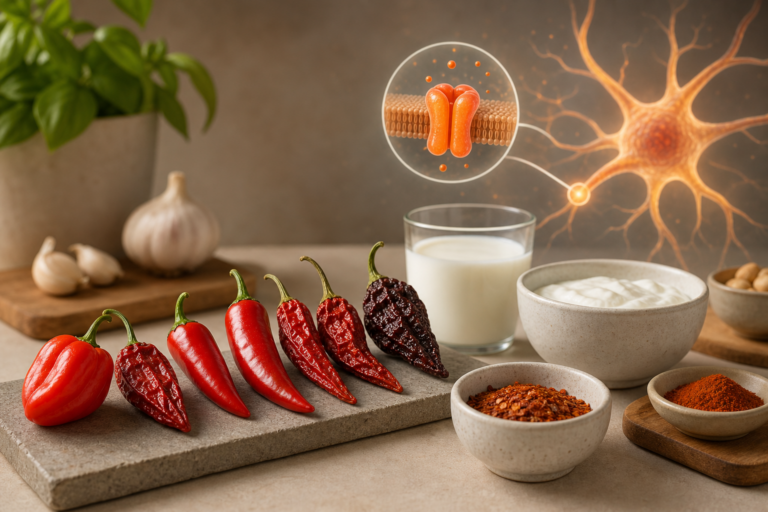
The burn you feel from a hot chili isn’t thermal in any conventional sense. Nothing in the pot is literally scorching your mouth. The culprit is capsaicin, a compound concentrated in the white pithy membrane inside chili pods. Capsaicin binds to a protein receptor on sensory nerve endings called TRPV1 — short for transient receptor potential vanilloid 1. Under normal circumstances, TRPV1 is activated by actual heat, specifically temperatures above roughly 43°C (109°F). Capsaicin hijacks this same channel, triggering what is effectively a false fire alarm. Your brain receives a pain signal identical to the one it gets from genuine heat, complete with the burning sensation, flushing, and watering eyes — all without a single degree of temperature change.
Understanding TRPV1 is the key to understanding why some remedies work instantly and others are a complete waste of precious seconds.
Why Water Makes Things Worse
The first instinct for most people is to down a glass of cold water. It feels logical — fire plus water should equal relief. But capsaicin is hydrophobic, meaning it actively repels water. It is also lipophilic, meaning it dissolves readily in fats and oils but not in water at all. Pouring water over capsaicin in your mouth is roughly equivalent to trying to rinse engine grease off your hands without soap: the molecules simply don’t bind to water. Worse, the swilling action redistributes capsaicin to new pain receptors across more of your oral surface. You don’t douse the fire — you spread it.
Dairy: The Evidence-Backed Champion
Milk, yogurt, sour cream, and ice cream are the most reliably effective remedies for chili burn, and science now explains precisely why. For decades, the fat content of dairy was assumed to be the primary mechanism — since capsaicin dissolves in lipids, fat-rich dairy should carry it away. That’s partly true. But researchers have identified an even more important player: casein, the dominant protein family in cow’s milk.
A 2023 study published in the Journal of Food Science by researchers at Penn State University examined how dairy proteins interact with capsaicin. The team found that casein binds directly to capsaicin molecules, reducing the concentration of free capsaicin available to stimulate TRPV1 receptors. Crucially, micellar casein — the natural form in which casein exists in milk — outperformed whey protein in its binding ability. When used as a mouth rinse following capsaicin exposure, a 5% micellar casein solution produced a 27% reduction in perceived oral burn at the one-minute mark compared to a plain water rinse. The effect was dose-dependent: higher casein concentrations correlated with lower maximum burn intensity across the study’s 89 participants.
This finding carries a practical surprise: skim milk is nearly as effective as whole milk at stopping the burn. Because the active agent is the casein protein rather than butterfat, removing the fat does not dramatically cut efficacy. Full-fat dairy still offers a combined benefit — protein binding plus fat-based dissolution — so whole milk and ice cream deliver a genuine one-two punch. But if only skim milk is available, reach for it without hesitation.
Other dairy foods work on the same principle. Plain yogurt and sour cream have the added advantage of thicker consistency, which coats the mouth and keeps casein in contact with affected tissue longer. It’s no coincidence that many of the world’s spiciest cuisines pair their heat with dairy accompaniments: Indian raita, Mexican crema, Turkish cacık. This is centuries of intuitive folk wisdom that biochemistry has since confirmed.
Bread and Starchy Foods: The Mechanical Absorber
When dairy isn’t available, starchy foods are the next best option — though they work through an entirely different mechanism. Bread, plain rice, crackers, and tortillas don’t chemically bind capsaicin the way casein does. Instead, they act as physical sponges, with starch granules and fibrous cell walls absorbing oily capsaicin residue from the surfaces of your mouth and reducing the amount in direct contact with pain receptors.
The effect is real but more modest. A dry or lightly toasted bread absorbs more effectively than a soft, dense slice because the porous texture provides greater surface area. Starchy foods work particularly well for managing the lingering burn after the acute peak has passed, mopping up residual capsaicin that clings to oral tissue. Think of bread as a mop rather than a fire extinguisher: useful for cleanup, but you wouldn’t fight the blaze with one.
Sugar and Honey: Partial Credit
Some people reach for a spoonful of sugar or honey, and there is a plausible mechanism here, even if the evidence is less robust than for casein. Sucrose appears to interact with sweet-taste receptors that share nerve pathways with pain-sensing receptors, potentially dulling the pain signal at a neurological level. Honey also coats the oral mucosa, forming a temporary barrier between capsaicin and tissue. Both effects are short-lived and do not remove capsaicin from the mouth the way dairy protein does. These are a short-term bridge, not a solution — useful if you need a few seconds of relief to think clearly, but insufficient on their own.
What to Avoid
Beyond water, alcohol is a frequently attempted but counterproductive choice. Capsaicin does dissolve in ethanol, but beer and wine contain nowhere near enough alcohol to make a meaningful dent — and the liquid volume simply spreads the problem further. Carbonated drinks compound the discomfort because the fizz appears to intensify the burn sensation on already-irritated tissue. Hot drinks are the worst option of all: heat independently activates TRPV1, stacking real thermal pain on top of the capsaicin-induced signal.
A Quick Reference Guide
- Best: Full-fat dairy — whole milk, yogurt, sour cream, ice cream. Casein binds capsaicin; fat dissolves it. Swish and swallow for maximum effect.
- Very good: Skim milk or low-fat dairy. Nearly as effective because the casein protein is what counts most.
- Decent: Plain bread, rice, or crackers. Physically absorbs residual capsaicin. More mop than extinguisher.
- Mild help: A spoonful of sugar or a drizzle of honey. Provides brief sensory relief but does not remove capsaicin.
- Avoid: Water, beer, fizzy drinks, hot beverages. All spread or amplify the burn rather than reducing it.
FAQ
Does cold water give any relief at all?
The low temperature briefly numbs nerve endings and creates a fleeting sense of relief — but it’s purely a cold effect, not a capsaicin-removal effect. As soon as the coldness dissipates, the burn returns, often feeling more intense because the capsaicin has now spread to new receptors. Cold dairy is a far better alternative: you get the numbing from the temperature plus genuine capsaicin removal from the casein.
Why does eating more chili sometimes seem to make the burn fade?
Prolonged or repeated stimulation of TRPV1 receptors triggers a process called desensitization. The continuous influx of calcium ions through the open receptor channel eventually impairs the receptor’s ability to keep firing. This is why habitual spicy food eaters develop real, physiological tolerance — not just a tougher mindset. The same mechanism underlies the use of topical capsaicin creams for pain relief: applied repeatedly, they exhaust local pain receptors.
Can plant-based milks substitute for dairy?
Most plant milks — oat, almond, rice — contain no casein and will not deliver the same binding effect. Soy milk contains proteins that may provide modest relief, and full-fat coconut milk offers a lipid layer that can dissolve some capsaicin. Neither matches dairy-based casein for efficacy, but both are meaningfully better than water. If dairy is not an option, full-fat coconut milk is the strongest plant-based substitute currently available.
Does the type of chili change how hard the burn is to stop?
Yes. Peppers vary enormously in total capsaicinoid content — the Scoville scale measures this concentration. A Carolina Reaper or ghost chili delivers a far larger capsaicin dose than a jalapeño, meaning more TRPV1 channels are activated simultaneously. The burn is deeper, longer-lasting, and may require multiple applications of dairy to fully clear. With very high-Scoville exposure, expect the process to take several minutes even with optimal remedies.
Sources
- ift.onlinelibrary.wiley.com
- psu.edu
- health.clevelandclinic.org
- edu.rsc.org
- ncbi.nlm.nih.gov
- sciencedaily.com
- pubmed.ncbi.nlm.nih.gov
- medicalxpress.com
Related Articles