
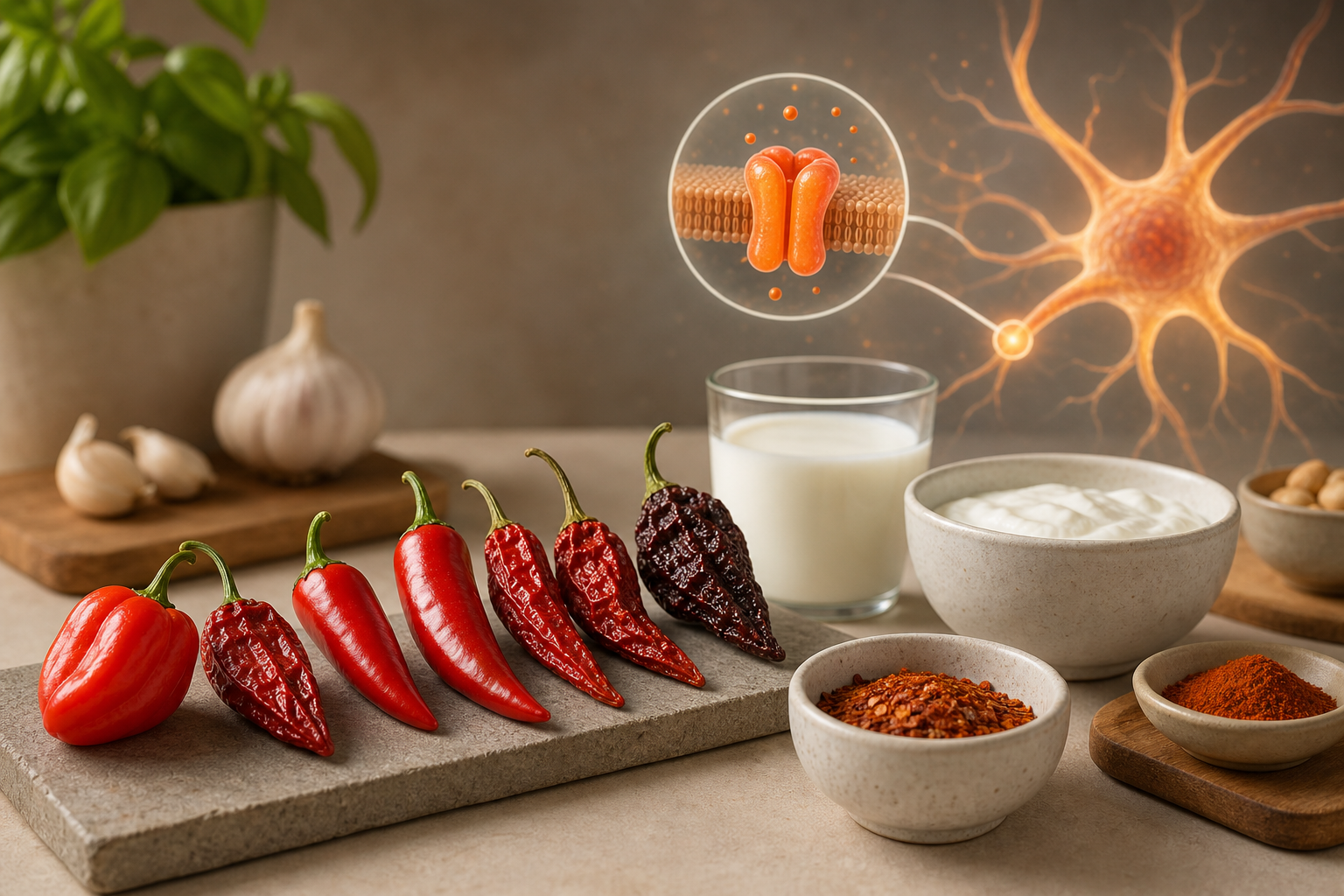
How to Build a Tolerance to Spicy Food, Safely: The Science of TRPV1 Desensitisation
The burning sensation from a hot chilli is not genuine heat — it is a sophisticated neural illusion produced by a single protein. Understanding that protein, called TRPV1, reveals why some people breeze through habaneros while others weep over jalapeños, and exactly how you can safely shift yourself toward the former camp.
Meet TRPV1: Your Body’s Fake-Fire Alarm
TRPV1 stands for Transient Receptor Potential Vanilloid 1. It is an ion channel embedded in the membranes of sensory neurons throughout your mouth, throat, oesophagus, and gut. Its normal job is to detect genuinely dangerous heat — temperatures above roughly 43 °C (109 °F). Capsaicin, the active compound in chilli peppers, hijacks this channel by binding at a pocket on the receptor’s inner surface, triggering it to open even at room temperature. Calcium and sodium ions flood in, the neuron fires, and your brain interprets the signal as burning pain. No tissue damage is occurring; the alarm is false.
This distinction matters enormously. Because no real injury is taking place, the nervous system can adapt to the stimulus — and that adaptation is the entire foundation of spice tolerance.
Two Layers of Desensitisation
Research on TRPV1 identifies two distinct but complementary processes by which repeated capsaicin exposure quiets the receptor’s response.
Acute Desensitisation
Within roughly the first twenty seconds of capsaicin contact, the TRPV1 channel begins dampening its own activity. The calcium ions that rush in when capsaicin opens the channel activate a protein called calmodulin, which in turn triggers the enzyme calcineurin to dephosphorylate — effectively switch off — the receptor. This is a rapid protective feedback loop. In practical terms, it explains why the peak burn of a chilli dish often softens to a duller warmth within half a minute, even if you keep eating. Functional recovery from this acute state requires the cell to replenish a membrane lipid called phosphatidylinositol 4,5-bisphosphate (PIP2), which normally takes around five to ten minutes.
Long-Term Adaptation and Receptor Downregulation
With sustained or frequently repeated exposure across days and weeks, a deeper structural change occurs. Neurons begin to internalise their surface TRPV1 receptors — withdrawing them from the membrane so fewer are available to bind capsaicin. This process, sometimes called tachyphylaxis or receptor downregulation, has been demonstrated in laboratory studies where twice-daily low-dose capsaicin exposure for fourteen consecutive days produced measurable desensitisation. The result is a lasting shift in the sensory apparatus: fewer alarm bells to ring, so the same dose of capsaicin rings fewer of them.
Importantly, this adaptation is reversible. If you stop eating spicy foods regularly, receptors recover over days to weeks and your threshold drops back toward baseline. Tolerance is maintained by consistency, not conquered once and held forever.
The Genetic Starting Line
Not everyone begins from the same position. Research suggests genetics account for roughly 15 to 58 percent of the variation in how people perceive and respond to capsaicin. Specific variants in the TRPV1 gene alter the shape of the capsaicin-binding pocket, making the receptor more or less sensitive to the compound. This is why some individuals genuinely feel more pain from the same pepper than others — it is not simply a matter of willpower or cultural exposure.
That said, the non-genetic portion of the variation — at least 42 percent and often much more — is shaped by lifetime habit and accumulated exposure. Even people born with highly sensitive receptors can train meaningful tolerance. It may simply take longer, and the personal ceiling may differ.
Building Tolerance Safely: A Practical Protocol
The cardinal principle is consistency over intensity. Leaping straight to the hottest peppers available causes suffering but not useful adaptation; the dose overwhelms feedback mechanisms before desensitisation can take hold. A graduated approach is far more effective.
Start at the Bottom of the Scoville Scale
The Scoville scale rates pepper heat from zero (sweet bell peppers) up through the hundreds and low thousands (jalapeños and serranos), into the hundreds of thousands (habaneros and Scotch bonnets), and beyond a million for superhot cultivars. Beginners should anchor in the hundreds-to-low-thousands range: mild salsa, a small amount of Tabasco stirred into familiar food, or the gentler end of Korean gochujang. The target is noticeable warmth, not distress.
Increase Gradually and Regularly
Aim to include spicy food in your diet at least three or four times per week. After one to two weeks at a given heat level without significant discomfort, nudge the intensity upward — not by doubling the concentration, but by a modest increment. Scientific evidence suggests functional desensitisation begins accumulating within fourteen days of consistent low-dose exposure, with meaningful tolerance to moderately spicy food typically emerging over a four-to-eight-week window. People with more reactive digestive systems should allow two to three months before expecting substantial change.
Never Eat Spicy Food on an Empty Stomach
TRPV1 receptors line not just your mouth but your entire gastrointestinal tract. Eating capsaicin-rich food without other food present removes the buffering effect of fats, starches, and proteins, allowing capsaicin to make rapid, concentrated contact with the gut lining. This can cause cramping and nausea well before your oral threshold feels challenged. Always eat spicy food alongside or after other foods.
Managing the Burn: What Actually Works
Capsaicin is a fat-soluble molecule, not a water-soluble one, so plain water does almost nothing to neutralise it — in fact, it can spread the compound to a wider area of mucous membrane and worsen the sensation. The most effective relief comes from dairy products: milk, yoghurt, and ice cream contain a protein called casein that physically binds capsaicin molecules and rinses them away. Starchy foods such as bread, rice, and tortillas also help by absorbing capsaicin-laden oils. A squeeze of citrus juice, while less potent than dairy, offers some relief and is worth reaching for when no milk is to hand.
Who Should Exercise Extra Caution
For most healthy adults, dietary capsaicin in ordinary culinary amounts is safe and even beneficial — large-scale epidemiological analysis has found that regular spicy-food consumers show a statistically significant reduction in cardiovascular mortality. However, several groups should approach tolerance-building carefully:
- People with acid reflux or GERD: Capsaicin can relax the lower oesophageal sphincter and aggravate symptoms.
- Those with inflammatory bowel disease (IBD): Active gut inflammation can be worsened by elevated capsaicin intake.
- Pregnant individuals: Severe gastrointestinal distress from very spicy food warrants a conservative approach.
- Anyone attempting viral “chilli challenge” videos: Concentrated capsaicin extracts at extreme doses — far beyond anything in culinary peppers — have caused documented medical emergencies. This is not tolerance training; it is chemical toxicity.
The Health Upside of Regular Capsaicin
Beyond an expanded menu, habitual moderate capsaicin consumption is associated with genuine physiological benefits. Emerging research suggests capsaicin promotes growth of beneficial gut bacteria — notably Akkermansia muciniphila, a species linked to reduced metabolic inflammation — by reaching the colon at meaningful concentrations. Capsaicin also triggers the release of endorphins, which partly explains why seasoned chilli eaters describe the experience as pleasurable rather than merely tolerable. A meta-analysis of cardiovascular outcomes found a hazard ratio of around 0.82 for heart-disease-related mortality among daily spicy-food consumers compared to those who rarely or never ate spicy food — a modest but meaningful signal.
FAQ
Does building spice tolerance dull my sense of taste overall?
No. TRPV1 desensitisation reduces the painful burning signal but does not significantly blunt your sensitivity to other flavours — sweet, salty, sour, and umami remain fully intact. Habitual spice eaters do show reduced sensitivity specifically to capsaicin heat, but the rest of the palate is unaffected.
How quickly does tolerance fade if I stop eating spicy food?
The receptor downregulation that underpins long-term tolerance is not permanent. After several weeks without capsaicin exposure, TRPV1 receptors can recover toward their original sensitivity, and dishes that once felt mild may sting again. Maintaining tolerance simply requires keeping spice a regular part of your diet.
How do I know if I am escalating too fast?
Persistent stomach cramps, acid reflux flares, or a burning sensation during digestion the morning after are clear signs to back off to a lower heat level and slow your progression. Severe pain, vomiting, or any sign of blood in the stool warrants medical attention immediately.
Are fresh peppers better for training than hot sauce?
Fresh and dried culinary peppers — jalapeños, serranos, Thai bird’s eye chillies, chipotles — are ideal because their capsaicin content is relatively consistent and arrives embedded in whole food, providing natural buffering from other macronutrients. Hot sauces work too, but check sodium content: some commercial sauces are so high in salt that using them as a daily training vehicle introduces a separate cardiovascular consideration.
Sources
- pmc.ncbi.nlm.nih.gov
- pmc.ncbi.nlm.nih.gov
- jneurosci.org
- varsity.co.uk
- redbloom.co
- thetakeout.com
- health.clevelandclinic.org
- scientificamerican.com