Does Water Stress Really Make Chili Peppers Hotter? What the Science Says
Gardeners who deliberately reduce watering during the fruiting phase frequently report angrier harvests, and a growing body of plant science confirms they’re onto something real. But the relationship between water stress and capsaicin is more nuanced than a simple “thirsty pepper, hotter pepper” rule — timing, cultivar genetics, and the severity of the stress all shape the outcome in ways that matter both to researchers and backyard growers alike.
What Capsaicin Is and Where It Comes From
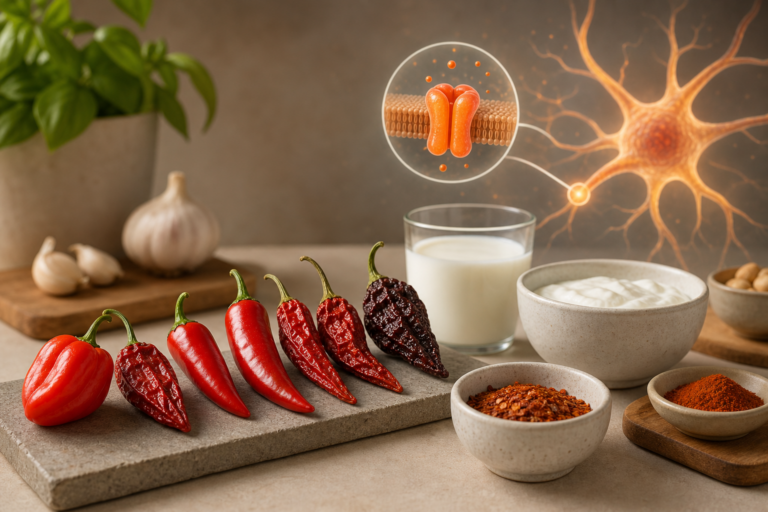
Capsaicin (chemical formula C18H27NO3) is the primary compound responsible for the burning sensation in chili peppers. It belongs to a family of alkaloids called capsaicinoids, which are synthesised almost exclusively in the placental tissue inside the fruit — the pale internal membrane to which the seeds attach. Capsaicin alone accounts for roughly 70 % of a pepper’s total capsaicinoid content, with dihydrocapsaicin making up most of the remainder. The compound works by binding to the TRPV1 nerve receptor in mammalian tissue, triggering a pain signal that mimics burning heat without actually causing tissue damage.
The Evidence: Water Stress Raises Capsaicin Concentrations
Multiple peer-reviewed studies now support the core claim. Research published in HortScience found that water-deficit treatments elevated capsaicinoid accumulation in Capsicum chinense — one of the hottest pepper species on the planet — compared with well-irrigated control plants. A separate study published in the Japanese Horticulture Journal produced some of the most striking numbers to date: drought-stressed ‘Shishito’ peppers recorded capsaicinoid concentrations of around 2,252 µg per gram dry weight at 20 days after flowering, compared with just 387 µg·g−1 in well-watered plants. The ‘Sapporo’ cultivar showed an even more dramatic divergence — approximately 32,499 µg·g−1 under drought versus around 2,766 µg·g−1 with excess water supply. Both cultivars also showed significantly elevated expression of capsaicinoid biosynthesis genes, including Pun1, pAMT, CaKR1, and the regulatory factor CaMYB31, under drought conditions.
A comprehensive review of factors influencing capsaicinoid metabolism, published through PubMed Central, confirmed that moderate drought consistently raises capsaicin and dihydrocapsaicin levels in most pepper types, while excessive irrigation tends to suppress them. One nuance the review highlighted: capsaicinoid content can initially dip after about 40 days of mild water restriction, then rebound and overtake control levels after 60 days. This reveals the response as a dynamic, time-sensitive biological process rather than a simple linear reaction to dryness.
The Biochemical Mechanism
The pathway from water-stress signal to hotter pepper passes through an elegant enzymatic cascade. Capsaicin biosynthesis draws on two metabolic routes: the phenylpropanoid pathway, which generates the vanillylamine portion of the molecule, and a branched-chain fatty acid pathway, which contributes the acyl side chain. The enzyme capsaicin synthase (CS) then joins the two components together. Two enzymes in the phenylpropanoid arm are especially important under drought:
- Phenylalanine ammonia-lyase (PAL) — the gateway enzyme that converts phenylalanine to cinnamic acid. Its activity rises markedly under drought stress and does so consistently across pepper cultivars of different pungency levels.
- Cinnamic-4-hydroxylase (C4H) — converts cinnamic acid to p-coumaric acid. Studies have found C4H activity peaks around 40 days after flowering in water-stressed plants and increases in direct proportion to measured capsaicin concentrations in the fruit.
Crucially, the degradation side of the equation matters just as much. Peroxidase (POD) enzymes in pepper tissue break capsaicinoids back down, and drought has been shown to suppress peroxidase activity while simultaneously activating biosynthetic enzymes. The result is a biochemical double effect: production accelerates while degradation slows, amplifying capsaicinoid accumulation beyond what either change alone would achieve.
At the regulatory level, drought activates transcription factors including CaMYB31 and WRKY9, which switch on downstream biosynthesis genes such as Pun1, pAMT, and KAS. This gene-level evidence helps explain why the heat response is not merely a passive concentration effect from reduced fruit water content, but an active upregulation of the plant’s capsaicin-making machinery.
Why Would a Plant Do This?
The prevailing evolutionary explanation holds that capsaicin evolved primarily as a deterrent against mammalian seed predators. Mammals chew and destroy seeds, eliminating their viability; birds, which disperse pepper seeds intact through their digestive tracts, lack the TRPV1 receptor that capsaicin targets and are unaffected by the heat. When a pepper plant faces water stress and uncertain reproductive success, investing more heavily in capsaicin production may be an adaptive strategy — protecting the seeds it does manage to set from mammalian consumption at precisely the moment those seeds matter most to the plant’s survival.
A secondary benefit may involve pathogen resistance. Capsaicinoids have demonstrated antifungal properties in laboratory settings, and a drought-weakened plant may benefit from this chemical shield against opportunistic soil fungi.
The Important Caveats
The general picture — water stress leads to hotter peppers — is well supported, but the research literature reveals several important qualifications that should temper any overly simple interpretation.
Timing Is Everything
Water stress during the fruiting and ripening stage is what consistently drives capsaicin upward. Stress applied during vegetative growth can actually reduce capsaicinoid content, and stress at the flowering stage appears to have relatively little effect on final pungency. Research on Capsicum chinense specifically found that plants stressed during the vegetative phase had significantly lower capsaicin than plants stressed during fruiting — a practically critical distinction that gardening advice often glosses over. Similarly, drought imposed at the pod-formation stage in some Capsicum varieties caused a measurable decrease in pungency rather than an increase, while antioxidant enzyme activity rose simultaneously, suggesting a biochemical trade-off that can redirect metabolic resources away from capsaicin under some stress conditions.
Cultivar Differences Are Substantial
Not every pepper responds identically. Research examining multiple cultivars found that moderate water stress boosted capsaicinoid yield in some varieties but reduced it in others. The pattern emerging across studies is that low- and medium-pungency varieties tend to show the largest gains under stress, while very high-pungency cultivars — already expressing capsaicin synthesis near their genetic ceiling — show smaller or negligible increases. A bell pepper, which lacks the functional Pun1 gene required for capsaicin biosynthesis, will remain non-pungent regardless of how much water stress it endures. Genetics set the ceiling; stress modulates where the plant operates within that range.
Concentration Versus Total Yield
There is a meaningful difference between capsaicin concentration per gram of fruit and total capsaicinoid yield per plant. Water-stressed plants typically produce less fruit biomass overall. This means that while each individual pepper may be measurably hotter, the plant’s total capsaicin output can actually fall. For a home grower seeking maximum heat-per-bite, moderate stress is a legitimate and evidence-backed strategy. For commercial capsaicin extraction, the tradeoff between concentration and total yield requires careful consideration of each cultivar’s response profile.
Severity Has a Sweet Spot
Mild to moderate drought activates biosynthesis genes and elevates capsaicin reliably. Severe, prolonged drought can overwhelm the plant’s metabolic capacity, ultimately reducing biosynthesis and causing fruit quality to decline across the board. The practical goal is controlled, targeted water restriction during fruiting — not a dying, wilting plant.
FAQ
Do other types of stress also increase capsaicin?
Water stress is the most extensively studied trigger, but other abiotic stressors — including elevated temperatures, salt stress, and certain nutrient limitations — have also been linked to higher capsaicinoid levels. Many of these pathways overlap at the signalling level, which may explain why peppers in challenging environments generally tend toward greater heat, even when specific stressors differ.
Can I make a mild pepper hot by withholding water?
Stress can amplify existing capsaicin-producing capacity, but it cannot override genetics. A low-pungency variety may become noticeably hotter under controlled water deficit; a bell pepper will not develop any heat at all, because the biosynthetic gene pathway is not functional in that variety regardless of growing conditions. Expect meaningful gains in mid-range varieties, modest gains in already-very-hot ones, and zero gain in non-pungent types.
Does soil type affect how stress influences capsaicin?
Yes. Sandy, free-draining soils expose roots to water deficit far more rapidly than clay-rich soils, which retain moisture longer. Growers attempting to induce mild stress during fruiting should account for their soil’s water-holding capacity rather than following a fixed irrigation interval based solely on calendar days. The target is a specific moisture level in the root zone, not a specific watering frequency.
Are the results consistent across all Capsicum species?
Not entirely. Most published research has focused on Capsicum annuum and Capsicum chinense. C. chinense appears to be particularly responsive to water-deficit treatments for capsaicinoid accumulation, but these findings should not be automatically generalised to all species or cultivars. If you are growing a less common species or a newly bred cultivar, the response to water stress may differ from what published studies predict.
Sources
- pmc.ncbi.nlm.nih.gov
- pmc.ncbi.nlm.nih.gov
- jstage.jst.go.jp
- pubmed.ncbi.nlm.nih.gov
- journals.ashs.org
- sciencedirect.com
- knowthepepper.com
- doi.org
Related Articles