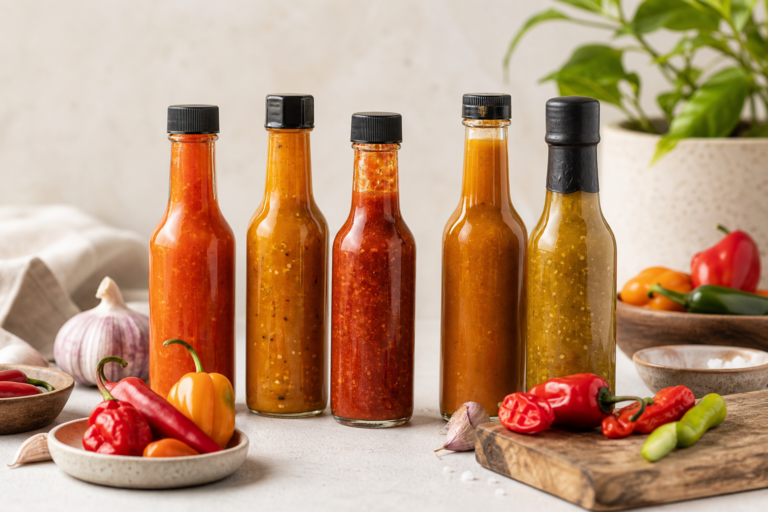
Homemade Fermented Hot Sauce: A Beginner’s Step-by-Step Guide
Few kitchen projects offer as much reward for as little effort as a jar of homemade lacto-fermented hot sauce — fiery, deeply tangy, and alive with the kind of layered heat that commercial bottles simply cannot replicate.
Yield: approximately 1½–2 cups | Prep time: 20 minutes | Fermentation time: 7–28 days (hands-off) | Difficulty: Beginner
What Is Lacto-Fermentation?
Lactobacillus bacteria, naturally present on the skins of fresh chillies, convert the peppers’ sugars into lactic acid during fermentation. That acid drops the brine’s pH below 4.6, creating an environment where harmful bacteria cannot survive — no heat processing or canning equipment required. The result is a probiotic-rich condiment with a depth of flavour that no vinegar-only hot sauce can match.
Ingredients
- 450 g (1 lb) fresh chilli peppers — red Fresnos, jalapeños, cayennes, or a mix, stems removed
- 1 medium carrot, sliced about 2 mm thick
- ½ small white onion, thinly sliced
- 4 garlic cloves, smashed and peeled
- 950 ml (1 quart) filtered or distilled water — do not use chlorinated tap water
- 3 tablespoons (45 g) non-iodized fine sea salt or kosher salt
- 3–4 tablespoons raw apple cider vinegar, added after fermentation
- 1 teaspoon honey or cane sugar (optional, for sweetness balance)
Instructions
- Clean your equipment. Wash a 1-quart (1-litre) wide-mouth glass mason jar, a fermentation weight or small zip-lock bag, and all utensils in hot soapy water and rinse well. Clean is the goal — you do not need to boil or sterilise with chemicals.
- Mix a 3% brine. Pour 950 ml of filtered water into a jug. Add 3 tablespoons (45 g) of non-iodized salt and stir for about one minute until fully dissolved. This 3% salt concentration is the recommended starting point for beginners — vigorous enough to support an active ferment while keeping unwanted organisms at bay. Reserve any leftover brine in the fridge; you may need it to top up the jar later.
- Prepare the vegetables. Put on food-safe gloves before handling chillies — capsaicin oils are difficult to remove from skin and will badly irritate your eyes. Slice peppers lengthways, remove the stems, and deseed if you prefer a milder sauce. Roughly chop the flesh into 2–3 cm pieces. Slice the carrot and onion thinly, and smash the garlic with the flat of a knife.
- Pack the jar. Add the peppers, carrot, onion, and garlic to the mason jar. Press firmly to pack everything in. Leave at least 4 cm (1½ inches) of headspace above the vegetables — the fermenting brine will bubble and expand.
- Pour in the brine. Pour the salt solution over the packed vegetables until they are fully covered and the brine sits within 2 cm (¾ inch) of the jar rim.
- Weigh the vegetables down. This is the single most important safety step: any pepper floating above the brine can grow mould. Place a glass fermentation weight on top of the vegetables, or press a small zip-lock bag filled with a splash of extra brine flat over the surface to hold everything under. Check the weight is secure before moving on.
- Cover loosely and start fermenting. Sit the lid on the jar without tightening it — CO₂ produced during fermentation must be able to escape or the jar will pressurise. If you have a dedicated airlock lid, use that instead. Place the jar on a small plate to catch any brine overflow, then move it to a cool, dark spot at 18–22 °C (65–72 °F). A kitchen counter away from direct sunlight, a pantry shelf, or a cool cupboard all work well.
- Monitor for 7–28 days. Check the jar daily. Within 2–3 days you should see small bubbles rising through the brine and the liquid beginning to turn cloudy — both are healthy signs that fermentation is underway. Taste a small amount of brine each time you check: at 7 days it will be bright and sharply acidic; at 14 days the flavour deepens and the heat mellows noticeably; by 28 days you have a more complex, rounded sauce. Stop fermenting when the flavour suits your taste. Discard the batch immediately if you see fuzzy, raised mould (not a flat white film — see the FAQ below) or if the brine smells genuinely rotten rather than pleasantly sour.
- Strain and blend. Once fermentation is complete, strain the solids through a colander into a bowl, reserving at least 1 cup of brine. Transfer the fermented vegetables to a blender. Add ½ cup of the reserved brine and 3 tablespoons of apple cider vinegar. Blend on high speed for 60–90 seconds until completely smooth.
- Adjust and season. Taste the blended sauce and adjust: add brine a tablespoon at a time to reach your preferred consistency (the sauce thickens slightly when refrigerated, so aim a touch thinner than you think you want), more vinegar for brightness, or a teaspoon of honey to round out aggressive heat. Blend briefly to combine.
- Optional: strain for a silkier texture. Pour the sauce through a fine-mesh sieve, pressing with a spoon to extract as much liquid as possible. The unstrained version has more body and deeper colour; the strained version pours more cleanly. Both are delicious.
- Bottle and refrigerate immediately. Funnel the finished sauce into clean glass bottles or jars and refrigerate straight away. The live culture will continue producing tiny amounts of CO₂ in the bottle, so do not use airtight flip-top bottles unless they go directly into the fridge. Stored refrigerated, the sauce keeps for 6–12 months and typically improves over the first few weeks. Shake or stir before each use.
Tips & Variations
- Adjusting heat: For a mild sauce, use mainly jalapeños or Fresnos. For serious heat, swap a quarter of the peppers for habaneros or scotch bonnets. Removing seeds and white pith at step 3 reduces the heat level further.
- Fruity ferment: Add 2–3 chunks of ripe mango or pineapple to the jar before fermenting. The fruit sugars ferment cleanly and add a tropical sweetness that pairs beautifully with fiery peppers.
- Smoky version: After blending, stir in ½ teaspoon of smoked paprika or chipotle powder.
- Salt precision: Measuring salt by weight rather than by volume gives consistent results. Different brands of sea salt and kosher salt have very different crystal sizes and pack very differently into a tablespoon — a scale removes the guesswork.
- Stopping the ferment: To halt fermentation completely and extend shelf stability, simmer the finished sauce at 82 °C (180 °F) for 10 minutes after blending. The sauce will be more shelf-stable once opened, but the heat processing destroys the live culture and its probiotic benefits.
- Water quality matters: The chlorine in municipal tap water actively suppresses Lactobacillus bacteria. Use filtered, bottled, or spring water. Alternatively, leave a jug of tap water uncovered overnight — most chlorine will off-gas by morning.
FAQ
Is it safe? How do I tell a good ferment from a bad one?
A healthy ferment smells pleasantly sour and tangy — like a good pickle or sourdough starter. Cloudy brine and rising bubbles are positive signs. Discard the batch immediately if the brine smells genuinely rotten (rather than just sour), or if you see fuzzy, raised mould with black, grey, pink, or orange colouring. A flat white film on the surface is almost always Kahm yeast, which is harmless but can add off-flavours; simply skim it away with a clean spoon and ensure the peppers are still fully submerged.
Do I need special fermentation equipment?
A clean 1-quart glass mason jar and a brine-filled zip-lock bag as a makeshift weight are all you truly need for a first batch. Dedicated airlock lids let CO₂ escape without daily intervention and reduce the risk of surface mould, but they are an optional upgrade rather than a requirement for a successful beginner ferment.
Can I use regular table salt?
No — regular iodized table salt is not suitable for fermentation. The iodine that prevents clumping in your salt shaker also suppresses the Lactobacillus bacteria you are trying to cultivate. Use non-iodized fine sea salt or kosher salt, and avoid any salt labelled with anti-caking agents, which can cloud the brine artificially.
My brine is not bubbling after three days — did it fail?
Not necessarily. Low room temperature (below 18 °C / 65 °F) is the most common reason for a sluggish ferment — move the jar somewhere a little warmer and wait another 24–48 hours. If you used chlorinated tap water, it may be suppressing microbial activity; discard the brine, refill with filtered water at the same 3% salt concentration, and restart. Very slow, cold ferments still succeed — they just take longer and can develop an interesting, more complex flavour.
Sources
- feastingathome.com
- peppergeek.com
- chilipeppermadness.com
- fermentedfoodlab.com
- homebrewersassociation.org
- escarpmentlabs.com
- salamandersauce.com
- thehomesteadingrd.com